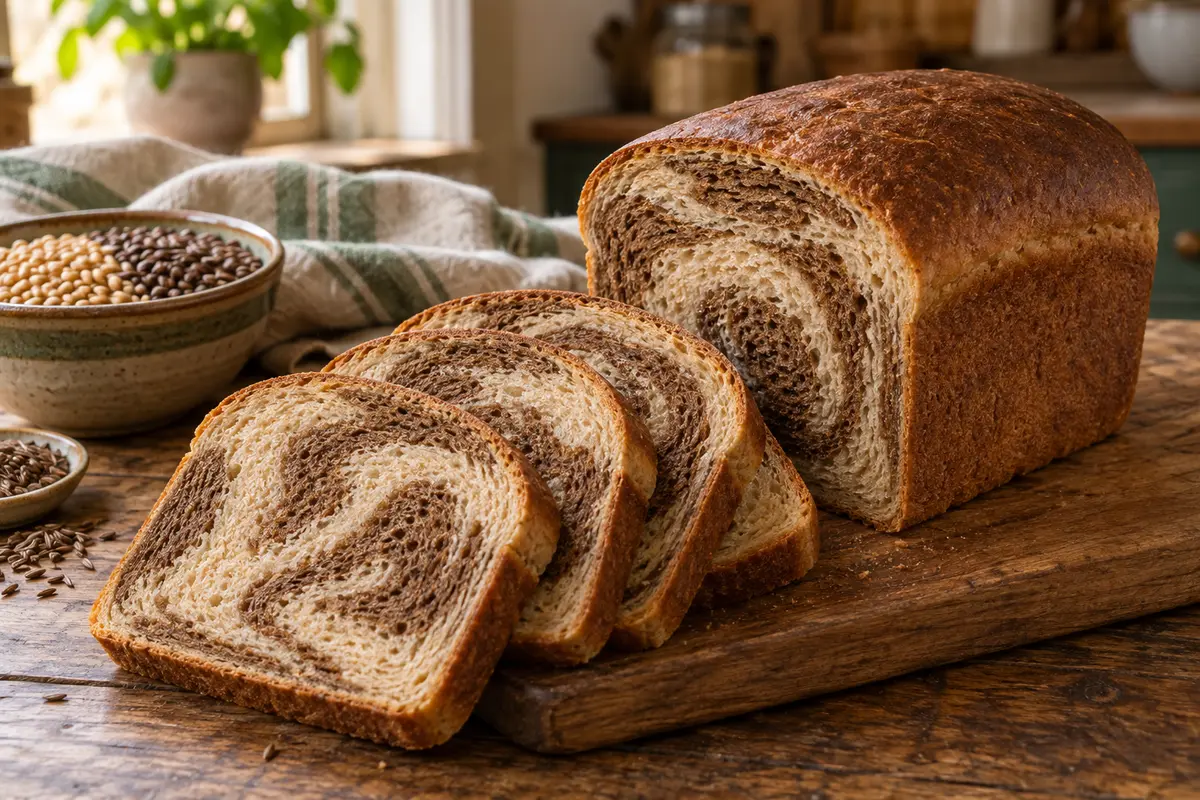
Classic marble rye gets its striking pattern by combining two portions of the same dough. The dark half uses a small amount of cocoa and molasses for color and depth—not enough cocoa to make the loaf taste like chocolate.
About the grain blend
Seventy percent hard white wheat supplies enough gluten strength for dependable sandwich slices. Thirty percent rye contributes earthy flavor and moisture without making the dough as paste-like as a high-rye loaf. The formula’s overall hydration is 74%, but the cocoa absorbs part of that water.
Ingredients
Base dough
- 350 g fresh-milled hard white wheat flour
- 150 g fresh-milled rye flour
- 355 g water, divided (start with 330 g)
- 20 g honey
- 25 g unsalted butter, very soft
- 10 g fine salt
- 6 g instant yeast
- 6 g caraway seeds, about 2 teaspoons, optional but traditional
Dark-rye paste
- 20 g unsulphured molasses
- 10 g unsweetened natural cocoa powder
- 15 g water
Baker’s percentages
| Ingredient | Weight | Baker’s percentage |
|---|---|---|
| Total flour | 500 g | 100% |
| Hard white wheat | 350 g | 70% |
| Rye | 150 g | 30% |
| Total water | 370 g | 74% |
| Honey + molasses | 40 g | 8% |
| Butter | 25 g | 5% |
| Salt | 10 g | 2% |
| Instant yeast | 6 g | 1.2% |
Method
- Mill and combine. Mill both grains finely. Mix the flours with 330 g water until no dry pockets remain. Cover and rest 20–30 minutes.
- Mix the base dough. Add honey, butter, salt, yeast, caraway, and up to 25 g of the reserved base-dough water as needed. Mix on low to medium-low for 6–8 minutes, until cohesive and moderately elastic. The dough should be tacky; rye prevents it from feeling like white bread dough.
- Divide. Weigh the dough and place about 55% in one greased bowl for the light portion. Put the remaining 45% back in the mixer or another bowl.
- Make the dark portion. Stir molasses, cocoa, and 15 g water into a smooth paste. Knead it gently into the smaller dough portion until the color is even. Avoid extended high-speed mixing.
- Bulk ferment. Cover both bowls and let rise until roughly 60–75% larger, generally 60–90 minutes around 75°F. The dark portion may appear slightly tighter.
- Build the marble. Divide each color into four pieces. Gently flatten the pieces into short rectangles and stack them in alternating colors. Press the stack together, stretch it to the length of the pan, and give it one gentle twist. Roll or tuck it into a snug log. Too many twists blur the colors.
- Pan and proof. Place seam-side down in a greased 9×5-inch pan. Cover and proof until the center crowns about 1 inch above the rim, usually 45–70 minutes.
- Bake. Bake at 375°F (190°C) on a rack slightly below center for 38–42 minutes. Tent with foil if the top darkens too quickly. The center should reach 198–202°F.
- Cool. Rest 10 minutes in the pan, then turn onto a rack. Cool at least 2 hours before slicing so the rye crumb sets cleanly.
How to keep the marble distinct
- Mix the cocoa paste completely into the dark portion before shaping.
- Keep the light and dark pieces thick enough to remain visible.
- Alternate four pieces of each color rather than rolling one very thin sheet over another.
- Use one gentle twist. More twisting creates muddy, narrow streaks.
- Slice only after full cooling; warm rye crumb smears easily.
Troubleshooting
The colors blended together: The pieces were made too thin or twisted too many times. Use fewer, thicker layers next time.
The dough feels very sticky: Rye is naturally tacky. Use damp hands and a scraper instead of adding enough flour to make it feel like white dough. Consult the sticky-dough guide.
The loaf is dense: Check that the hard white wheat is truly a hard bread wheat, and judge fermentation by volume rather than the clock.
The top separates from the swirl: Press the stacked pieces together before twisting, and roll the final log with steady tension so large gaps are not trapped.
Variations
- No caraway: Omit it for a milder family sandwich loaf.
- Caraway crust: Brush the proofed loaf lightly with water and sprinkle with 1 teaspoon additional seeds.
- More rye: Increase rye only with care; higher percentages need more water and produce less elastic dough.
- Two-color rolls: Divide the marbled log into eight pieces, place in a greased pan, and begin checking around 22–26 minutes.
Fresh-Milled Bread Basics
This recipe is part of Grainiac’s ten-recipe foundation series:
Rye: One Grain, Five Ways
Put this grain to work in five practical forms:
Products Used in This Recipe
A scale and scrapers make dividing and shaping two colors much easier.
OXO 11-lb Digital Food Scale
For weighing the dough portions and keeping the formula repeatable.
View on Amazon ↗Affiliate link · commission may be earnedStainless Bench Scraper
For dividing, stacking, and shaping the marbled dough cleanly.
View on Amazon ↗Affiliate link · commission may be earnedFine-Mesh Flour Sifter
Optional when a measured reduction in coarse bran is wanted.
View on Amazon ↗Affiliate link · commission may be earnedNutriMill Artiste Stand Mixer
Useful for mixing the base dough and incorporating the dark paste.
View on Amazon ↗Affiliate link · commission may be earnedAffiliate disclosure: As an Amazon Associate I earn from qualifying purchases. Recommendations are chosen for practical usefulness, not commission.
Learn more
Core references: Read the Fresh-Milled Flour Guide, use the Hydration Chart, troubleshoot dense bread and sticky dough, and review the recommended baking tools.
Use the Fresh-Milled Flour Hydration Chart, review autolyse, soakers and bran, or start with the Beginner Hard White Wheat Sandwich Bread.
← Back to all recipes