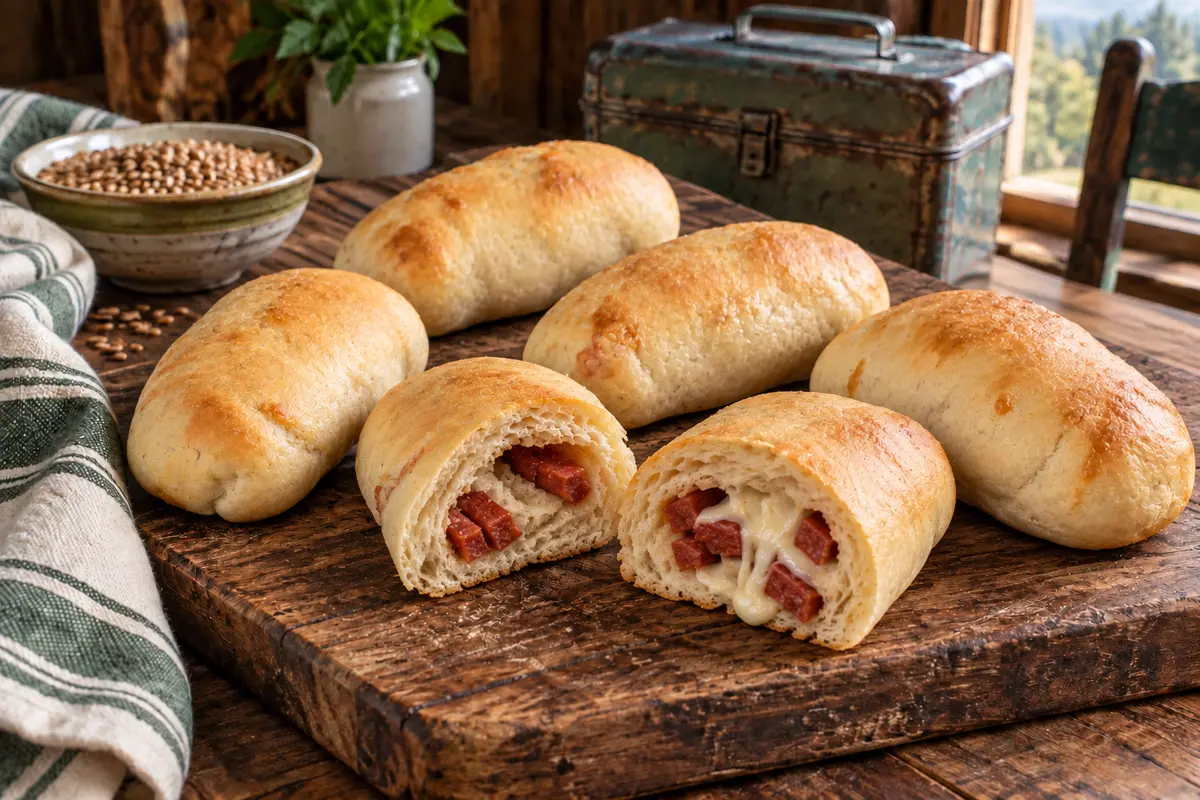
Pepperoni rolls are simple on purpose: soft bread dough baked around pepperoni so its seasoned oil flavors the crumb from the inside. This version keeps that sturdy character while bringing fresh-milled hard white wheat to the dough.
A West Virginia lunch-pail tradition
The commercial pepperoni roll is generally credited to Giuseppe “Joseph” Argiro of Country Club Bakery in Fairmont in 1927. Bread and pepperoni made a compact, filling lunch for north-central West Virginia coal miners. The original style was plain bread and pepperoni; cheese, peppers, and sauce came later.
Ingredients
Dough
- 350 g fresh-milled hard white wheat flour, finely milled
- 150 g organic bread flour
- 335 g water, divided (start with 310 g)
- 25 g honey or sugar
- 35 g unsalted butter, very soft
- 10 g fine salt
- 7 g instant yeast
Filling and finish
- 600 g stick pepperoni or thick pepperoni strips, divided into 12 portions (about 50 g each)
- 120 g provolone, mozzarella, or pepper-jack cheese, optional
- 20 g melted butter for brushing, optional
Baker’s percentages
| Ingredient | Weight | Baker’s percentage |
|---|---|---|
| Total flour | 500 g | 100% |
| Fresh-milled hard white wheat | 350 g | 70% |
| Organic bread flour | 150 g | 30% |
| Water | 335 g | 67% |
| Butter | 35 g | 7% |
| Honey or sugar | 25 g | 5% |
| Salt | 10 g | 2% |
| Instant yeast | 7 g | 1.4% |
Method
- Hydrate the flour. Combine both flours with 310 g water until no dry flour remains. Cover and rest 20–30 minutes.
- Mix the dough. Add honey, butter, salt, and yeast. Mix on low to medium-low for 7–9 minutes, adding the reserved 25 g water a little at a time only if needed. The dough should be smooth, elastic, and slightly tacky.
- Bulk ferment. Cover and rise until about 60–75% larger, generally 60–90 minutes around 75°F. Do not wait for the dough to weaken after a dramatic doubling.
- Divide. Turn out the dough and divide into 12 pieces of approximately 75 g each. Round lightly, cover, and rest 10 minutes.
- Fill. Flatten one piece into a small oval. Place about 50 g pepperoni lengthwise in the center, using three to five sticks depending on how thickly they are cut. Add about 10 g cheese if using. Bring the long sides over the filling, pinch firmly, then seal the ends. No pepperoni should be exposed.
- Proof. Arrange seam-side down on two parchment-lined sheet pans with room between them. Cover and proof until visibly puffy, about 35–55 minutes.
- Bake. Bake at 375°F (190°C) for 18–22 minutes, rotating the pans once if needed. The rolls should be evenly golden and approximately 195°F in the bread portion.
- Finish. Brush lightly with melted butter for a softer crust, if desired. Cool at least 20 minutes before eating—the pepperoni oil inside is considerably less patient than you are.
Modern organic-wheat version
For a lighter, more traditional white-bread texture, replace both flours with 500 g King Arthur Organic Bread Flour. Begin with 315 g water and add up to 10 g more as needed. Keep every other ingredient and the filling unchanged.
- Mix flour with 300 g water and rest 15 minutes.
- Add the remaining dough ingredients and mix to a moderate windowpane, adding reserved water as needed.
- Let rise until nearly doubled, divide, fill, and proof until puffy.
- Bake at the same temperature and time.
Make them well
Seal firmly: Pepperoni fat liquefies during baking. A loose seam allows it to escape instead of flavoring the bread.
Do not overfill with cheese: Cheese is good; a baking-sheet lake of cheese is less helpful. Keep it to about 10 g per roll and seal it fully.
Use two pans: Crowded rolls steam each other and brown unevenly. Give them working room.
Storage: Keep plain rolls tightly wrapped at room temperature for up to 1 day or refrigerate up to 4 days. Refrigerate cheese-filled rolls after cooling. Reheat at 300°F for 7–10 minutes or enjoy at room temperature.
Fresh-Milled Bread Basics
This recipe is part of Grainiac’s ten-recipe foundation series:
Grains & Tools Used in This Recipe
OXO 11-lb Digital Food Scale
For equal 75 g dough portions and consistent pepperoni filling.
View on Amazon ↗Amazon affiliate link · commission may be earnedStainless Bench Scraper
For dividing twelve clean, even portions without tearing the dough.
View on Amazon ↗Amazon affiliate link · commission may be earnedKing Arthur Organic Bread Flour
Used for the 30% modern-wheat portion and the alternate all-modern formula.
View product ↗King Arthur Baking affiliate link · commission may be earnedSAF Red Instant Yeast
Reliable instant yeast for the fresh-milled and modern-wheat versions.
View product ↗King Arthur Baking affiliate link · commission may be earnedAffiliate disclosure: As an Amazon Associate I earn from qualifying purchases. I may also earn from qualifying King Arthur Baking purchases through Awin. Recommendations are chosen for practical usefulness, not commission.
Learn more
Core references: Read the Fresh-Milled Flour Guide, use the Hydration Chart, troubleshoot dense bread and sticky dough, and review the recommended baking tools.
Start with the Beginner Hard White Wheat Sandwich Bread, use the Fresh-Milled Flour Hydration Chart, or troubleshoot with Why Is My Fresh-Milled Dough So Sticky?.
← Back to all recipes