The short answer
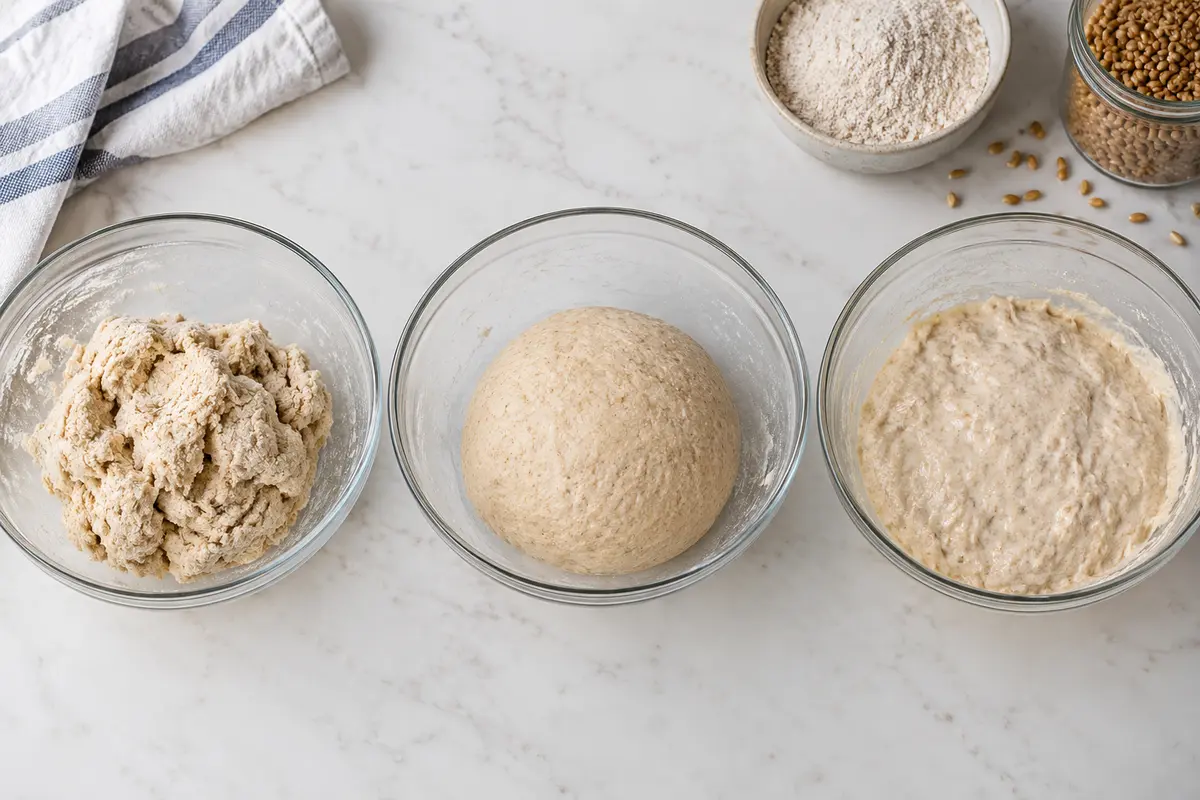
Properly hydrated fresh-milled dough is cohesive, flexible, and slightly tacky after its rest. It should stretch without immediately tearing, release from damp hands with minimal residue, and hold some shape between folds. Judge it after the flour has had time to absorb water—not during the first minute of mixing.
Start with the math
Hydration is water weight divided by flour weight. A dough with 700 g water and 1,000 g flour is 70% hydration. Count water contributed by liquid starter, milk, yogurt, eggs, or purées when precision matters. The percentage is a comparison tool, not a guarantee: bran size, extraction, grain variety, milling temperature, and storage all change absorption.
Why the first five minutes mislead
Fresh bran and germ absorb water gradually. A dough that looks shaggy at first may become supple after 20–30 minutes. Adding water too quickly can leave you with a slack dough once the rest catches up. Mix flour with most of the water, reserve 5–8%, rest, then decide.
| Grain | Sensible hearth-loaf starting range | What to watch |
|---|---|---|
| Hard white/red wheat | 70–78% | Bran may keep drinking during bulk. |
| Spelt | 65–72% | Can feel strong early, then turn slack if overmixed. |
| Einkorn | 58–65% | Sticky does not necessarily mean thirsty; it dislikes aggressive kneading. |
| Emmer | 65–72% | Benefits from a rest but has moderate gluten strength. |
| Khorasan/Kamut | 68–75% | Often absorbs well but becomes extensible. |
| Rye blends | Varies widely | Rye feels pasty and is judged differently from wheat dough. |
These are starting ranges, not rules. Pan loaves may use less; sifted flour may need less; strong hard wheat may accept more.
Under-hydrated cues
- Dry flour remains after two or three minutes of mixing.
- The dough tears during a gentle fold and the torn edge looks rough.
- It resists shaping like a tight rubber ball.
- The baked crumb is uniformly tight even when fermentation was adequate.
Add water by bassinage: wet your hands, dimple in 5–10 g at a time, fold gently, and wait several minutes before deciding again.
Properly hydrated cues
- The surface becomes smoother during the rest and first folds.
- The dough feels tacky but does not coat the hand like paste.
- It stretches, then offers gentle resistance.
- It relaxes between folds but still gathers into a rounded mass.
- Gas bubbles remain suspended rather than racing to the surface.
Too-wet—or merely undeveloped?
Fresh-milled dough often begins sticky. Before adding flour, give it a 20-minute rest and one or two folds. True excess water shows itself later: the dough spreads immediately after every fold, cannot hold tension, leaves a heavy coating on hands, and weakens as bulk proceeds.
Keep a useful notebook
Record grain, extraction, flour temperature, total hydration, dough temperature, room temperature, rest length, bulk time, and result. “70% hydration” means little without the rest. After three bakes, your notebook becomes more valuable than a generic chart.
Helpful tools
A scale makes controlled 5–10 g adjustments possible; a clear straight-sided container reveals rise without guesswork.
See scales, thermometers and dough tools → Find grain sources →
Affiliate disclosure: Some linked products may earn The Grainiac a commission at no extra cost to you.