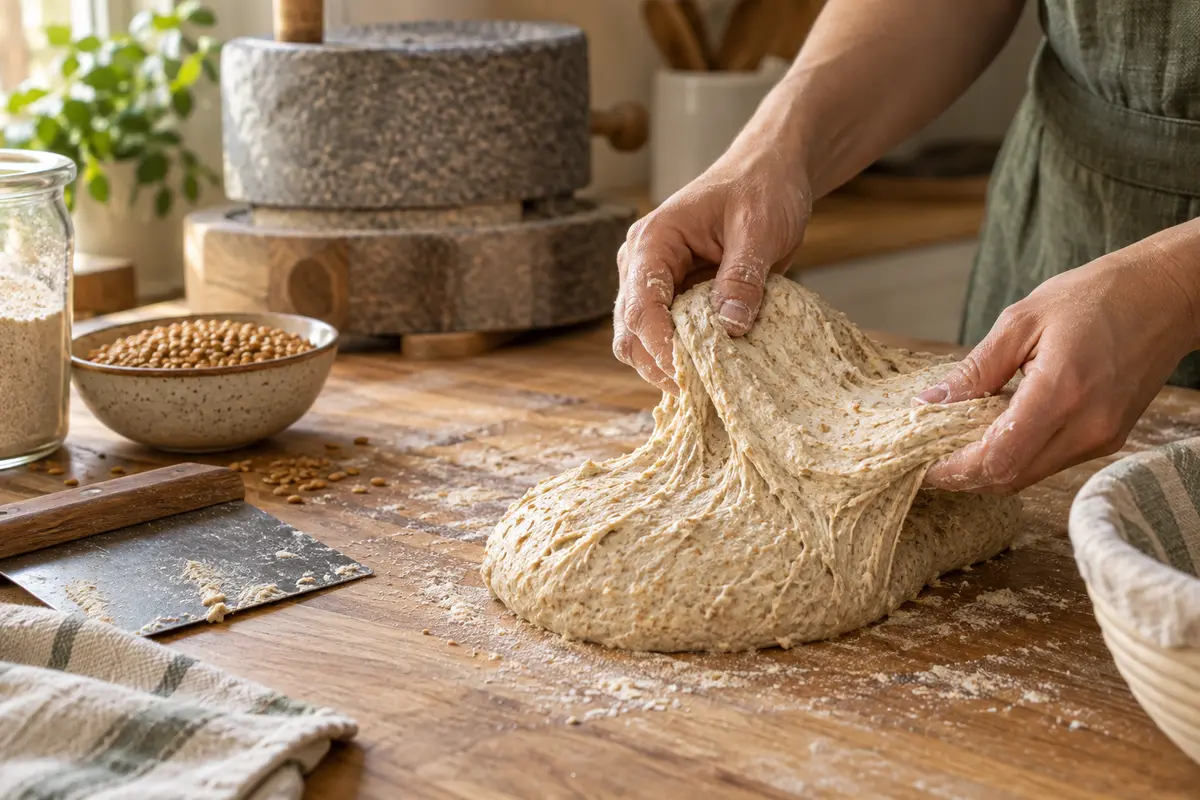
The short answer
Fresh-milled dough is often stickier because the bran and germ hydrate slowly, whole-grain particles interrupt the gluten network, and ancient wheats such as einkorn and spelt form softer, more extensible doughs. Before reaching for more flour, give the dough time to rest and one or two gentle folds.
If it remains paste-like, spreads immediately after every fold, or grows weaker during bulk fermentation, investigate hydration, grain strength, dough temperature, and fermentation.
Tacky, sticky, or slack?
These words are often used interchangeably, but they describe different handling problems.
| What you observe | What it usually means | First response |
|---|---|---|
| Tacky: dough clings lightly but releases from damp fingers | Often normal and properly hydrated | Continue resting and folding; do not add flour automatically |
| Sticky: dough coats the fingers or scraper | May be normal early, underdeveloped, warm, or slightly overhydrated | Rest 15–20 minutes, then reassess after a fold |
| Slack: dough spreads and will not retain tension | Weak structure, excessive water, overfermentation, or grain limitations | Check temperature and fermentation; use gentle folds or a pan |
| Pasty: dough behaves more like clay or paste than elastic wheat dough | Expected with substantial rye; possible severe overhydration in wheat dough | Judge rye by its recipe method, not by wheat-dough standards |
Diagnose it in the right order
- Identify the grain. Einkorn, spelt, Kamut, emmer, hard wheat, and rye do not produce the same dough.
- Check the recipe’s true hydration. Count water in the starter and remember that milk, eggs, yogurt, honey, and purées contribute liquid.
- Allow absorption time. Fresh bran can make dough seem both wet and dry at the same time: sticky outside, stiff inside.
- Check dough temperature. Warm dough feels softer and ferments faster.
- Check fermentation progress. Dough that began manageable but later became sticky and shapeless is often overfermented rather than under-floured.
Seven common causes
1. The flour has not finished absorbing water
Freshly milled bran and germ do not hydrate instantly. Mixing harder during the first few minutes often smears the dough without solving the problem. Rest it for 20–30 minutes, then fold once before deciding whether it truly contains too much water.
2. Hydration is too high for that grain
A hydration that works beautifully with hard white wheat may overwhelm einkorn. Likewise, a percentage suited to focaccia may be unsuitable for a free-standing loaf. Consult the Fresh-Milled Flour Hydration Chart and begin near the lower end until you know your grain.
3. The grain naturally forms weaker gluten
Einkorn produces sticky, extensible dough and rarely behaves like modern bread flour. Spelt and Kamut may develop quickly but lose strength if mixed aggressively. Emmer generally favors modest hydration and gentle handling. More kneading is not always more strength.
4. The dough is too warm
Warm dough feels softer, sticks more readily, and moves through fermentation quickly. If flour comes from the mill warm, use cooler mixing water and measure the finished dough temperature. For many wheat breads, roughly 75–78°F is a practical target, though the recipe and schedule should govern.
5. The dough was overmixed
Ancient-grain dough can move from cohesive to smeared and slack when mixing continues beyond its useful development. Stop once the dough has become reasonably smooth and cohesive. Build additional strength with spaced folds rather than sustained high-speed mixing.
6. Bulk fermentation went too far
Overfermented dough becomes gassy, fragile, increasingly sticky, and difficult to shape. It may tear around large bubbles and spread after turning out. Adding flour at this stage does not restore the damaged structure. Shape gently, use a pan if necessary, and shorten bulk next time.
7. Rye or coarse bran changes the rules
Rye’s pentosans bind water and produce a tacky or paste-like dough without the elastic gluten structure expected from wheat. Coarse wheat bran can also cut developing gluten. A rye-heavy formula should be handled with wet tools and judged according to its intended rye-bread method.
What stickiness means by grain
| Grain | Normal behavior | Best handling approach |
|---|---|---|
| Hard white or hard red wheat | Tacky early, then increasingly elastic after rest and folds | Reserve water, rest well, and use structured folds |
| Spelt | Soft, extensible, sometimes strong early and slack later | Mix briefly and avoid pushing bulk fermentation too far |
| Einkorn | Persistently sticky with limited elasticity | Use lower hydration, damp hands, gentle folds, and often a pan |
| Emmer | Moderately sticky with less height than strong wheat | Use a modest hydration and avoid aggressive kneading |
| Kamut | Silky and extensible; can loosen as fermentation advances | Develop gently and shape before the dough becomes too relaxed |
| Rye | Tacky or pasty rather than stretchy | Use wet hands and tools; do not chase a windowpane |
Handle sticky dough without burying it in flour
- Use damp hands during mixing and folding. Re-wet lightly rather than soaking the dough.
- Use a bench scraper to lift, turn, and tighten dough without pulling it apart.
- Rest between folds. Ten seconds of folding followed by twenty minutes of rest often does more than prolonged kneading.
- Lightly oil the bulk container when the recipe permits, but avoid heavy oil that hides the dough’s actual texture.
- Flour the work surface strategically. Use only enough during final shaping to prevent adhesion; keep the seam side slightly tacky so it seals.
- Choose a pan when necessary. A flavorful dough is not a failure merely because it needs support. Bread has been using pans for a good while now—it will not take offense.
Can sticky dough be rescued?
Slightly sticky but strengthening: Continue with gentle coil folds or stretch-and-folds.
Too wet early in mixing: Add a measured amount of flour in small increments, then record the new total so the recipe can be corrected next time.
Warm and fermenting too quickly: Move it to a cooler location and shorten the planned bulk time. Avoid chilling it so aggressively that fermentation stops unevenly.
Overfermented and collapsing: Handle minimally, place it in a greased loaf pan, proof only as needed, and bake. It may not be the grand boule you planned, but toast is a forgiving institution.
Make the next batch easier
- Weigh flour and water rather than measuring by cups.
- Record the exact grain and milling or sifting method.
- Hold back 5–8% of the water until after the rest.
- Record flour, water, and finished dough temperatures.
- Mark the bulk container so rise can be judged by volume.
- Change only one variable on the next bake.
A sound rule
If the dough is sticky but gains strength after resting and folding, keep going. If it grows weaker, warmer, and more shapeless, stop adding time and start checking hydration and fermentation.