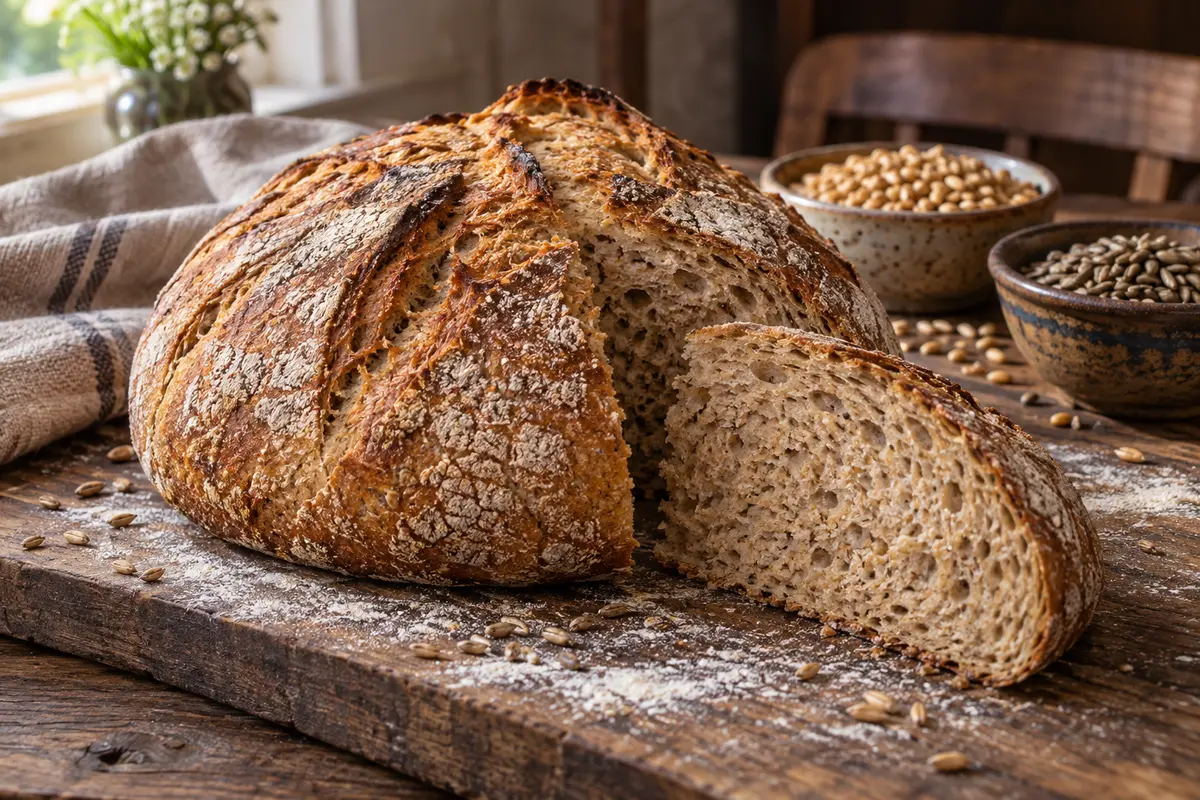
Thirty percent rye brings earthy flavor and moisture without turning the loaf into a brick. The dough will feel tackier than wheat dough and will never develop the same windowpane, so folds and visual fermentation cues matter more than heroic kneading.
Ingredients
- 350 g fresh-milled hard white wheat flour
- 150 g fresh-milled whole rye flour
- 365 g water, divided (start with 345 g)
- 10 g honey, optional
- 10 g fine salt
- 4 g instant yeast
- Rice flour or wheat flour for the banneton
Baker’s percentages
| Ingredient | Weight | Baker’s percentage |
|---|---|---|
| Hard white wheat flour | 350 g | 70% |
| Whole rye flour | 150 g | 30% |
| Water | 365 g | 73% |
| Honey | 10 g | 2% |
| Salt | 10 g | 2% |
| Instant yeast | 4 g | 0.8% |
Method
- Combine both flours with 345 g water. Rest 25–35 minutes.
- Add honey, salt, and yeast. Mix until cohesive, adding reserved water only as the dough can hold it.
- Over the next 60 minutes, perform three sets of stretch-and-folds 20 minutes apart. Handle with damp hands.
- Continue bulk fermentation until roughly 60% larger, aerated at the edges, and gently domed, usually another 30–60 minutes.
- Pre-shape into a round, rest 15 minutes, then shape firmly without degassing completely. Place seam-side up in a floured 9-inch banneton.
- Proof 35–60 minutes while a covered Dutch oven heats at 475°F. The dough should slowly spring back when pressed.
- Turn onto parchment, score, load into the hot pot, reduce to 450°F, and bake covered 25 minutes. Uncover, reduce to 425°F, and bake 17–23 minutes more.
- Cool at least 3 hours before slicing; rye crumb sets slowly.
Make it well
Rye stays tacky. Use damp hands and a scraper instead of adding handfuls of flour.
For a milder loaf, omit the honey; for classic rye character, add 1 teaspoon caraway.
The crust is ready when deeply golden and the center reaches about 205°F.
Fresh-Milled Bread Basics
Build confidence one loaf at a time. These ten recipes cover the everyday shapes and dough styles worth mastering.
Recommended Tools
Use what you already own when it works well; these are the tools that make fresh-milled bread more repeatable.
OXO 11-lb Digital Food Scale
For accurate flour, water, and dough-portion weights.
View on Amazon ↗Affiliate link · commission may be earnedStainless Bench Scraper
For dividing, shaping, and cleaning tacky dough.
View on Amazon ↗Affiliate link · commission may be earnedFine-Mesh Flour Sifter
Optional when a measured reduction in coarse bran is desired.
View on Amazon ↗Affiliate link · commission may be earnedNutriMill Artiste Stand Mixer
A high-capacity mixer with a dough hook for fresh-milled dough.
View on Amazon ↗Affiliate link · commission may be earnedSee the complete baking tools and equipment guide →
Affiliate disclosure: As an Amazon Associate I earn from qualifying purchases. Recommendations are chosen for practical usefulness, not commission.
Guides for better bread
Start with the Fresh-Milled Flour Guide, use the Fresh-Milled Flour Hydration Chart, and troubleshoot with Why Is My Fresh-Milled Bread Dense? and Why Is My Fresh-Milled Dough So Sticky?.
← Back to all recipes