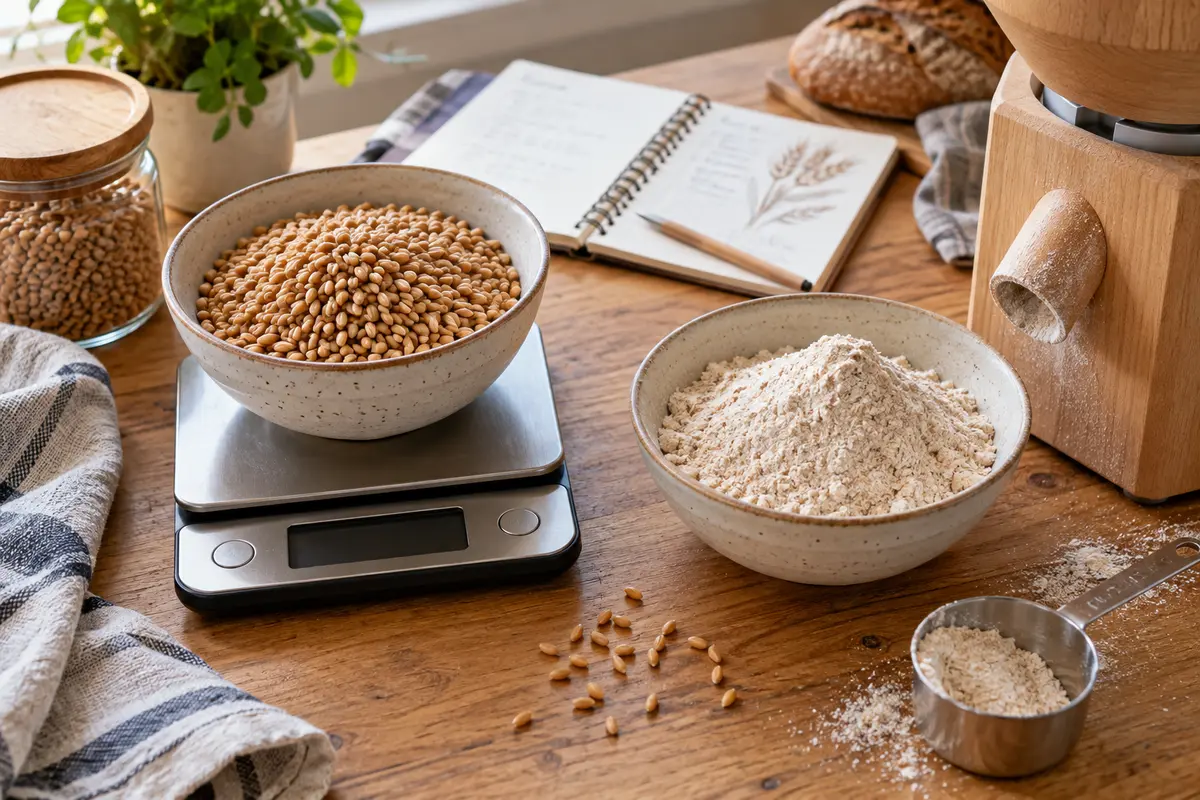
If a recipe needs 500 g whole-wheat flour, begin with 500 g wheat berries. Milling changes particle size, not the mass of the grain. In real kitchens, a small amount remains in the hopper, stones, chamber, chute, or air as dust, so a modest allowance is useful.
The useful answer
This guide gives you a starting point, then shows you what to observe and record in your own kitchen. Grain variety, mill setting, temperature, and recipe design all matter more than a single universal rule.
For unsifted flour, weight is nearly one-to-one
A practical starting allowance is 2–4%, then replace that estimate with your own mill’s measured retention.
Quick milling chart
| Flour needed | Berries at +2% | Berries at +4% |
|---|---|---|
| 250 g | 255 g | 260 g |
| 400 g | 408 g | 416 g |
| 500 g | 510 g | 520 g |
| 750 g | 765 g | 780 g |
| 1,000 g | 1,020 g | 1,040 g |
The formula when you sift
If you want 500 g flour at 90% extraction with a 2% mill allowance:
500 ÷ 0.90 × 1.02 = 567 g berries
Extraction rate is the percentage of original grain mass remaining in the flour after sifting. Weigh both retained flour and removed bran; do not guess by how fluffy the sieve looks.
Measure your mill once
- Weigh 500 g clean berries.
- Mill normally.
- Wait for the mill to finish clearing.
- Weigh the flour output.
- Calculate retention: 500 g minus output.
If output is 490 g, the system retained 10 g, or 2%. Repeat twice before treating it as your normal allowance.
Why cups fail here
A cup of berries and a cup of flour do not weigh the same, and flour volume changes with fineness, settling, humidity, and scooping. Weigh the recipe flour and the berries. Your scale is cheaper than repeatedly discovering half a cup of flour in the mill after the dough is mixed.
What to do with extra flour
Small leftovers can feed a starter, dust a banneton, thicken gravy, or join the next bake. For longer storage, cool the flour, seal it airtight, label the grain and date, and refrigerate or freeze it. Better yet, refine your mill allowance until leftovers become intentional.
For sifting strategy, read Should You Sift Fresh-Milled Flour?
Useful tools
Affiliate disclosure: As an Amazon Associate I earn from qualifying purchases. Recommendations are selected for practical usefulness.