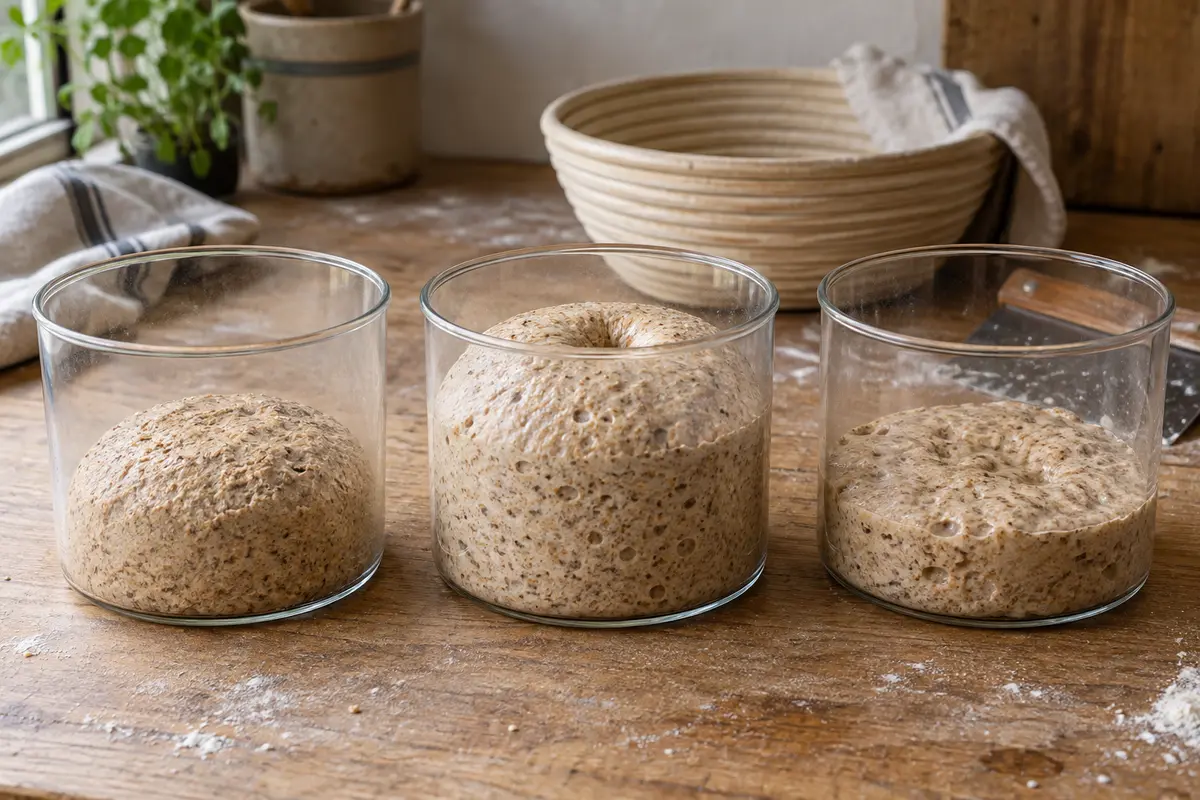
Fresh-milled dough does not proof on a universal schedule. Grain strength, flour temperature, dough temperature, starter or yeast activity, hydration, and pan shape all change the pace. “Proof 60 minutes” is a planning estimate. The dough still gets the final vote.
The useful answer
This guide gives you a starting point, then shows you what to observe and record in your own kitchen. Grain variety, mill setting, temperature, and recipe design all matter more than a single universal rule.
The clock is supporting evidence—not the verdict
Judge several cues together: expansion, trapped gas, surface tension, movement, and response to touch. One cue by itself can mislead.
Bulk fermentation and final proof are different decisions
| Stage | What you are deciding | Useful cue |
|---|---|---|
| Bulk fermentation | Has the dough built enough gas and fermentation strength to divide or shape? | 30–75% volume growth, bubbles at edges, lighter feel |
| Final proof | Has the shaped loaf expanded enough to bake without tearing or collapsing? | Visible crown, gentle jiggle, slow partial spring after pressing |
Many fresh-milled doughs should not double during bulk. A strong hard-white-wheat pan loaf may tolerate 60–75% growth. Einkorn, spelt, emmer, and Kamut often benefit from shaping earlier, before the dough becomes fragile and slack.
Five cues to read together
- Mark the starting height. Use a straight-sided container or a small aliquot jar.
- Look for gas. Bubbles along the wall and a slightly domed surface show active fermentation.
- Lift the bowl. Properly fermented dough feels aerated and alive rather than heavy and pasty.
- Watch movement. A proofed pan loaf trembles gently when the pan is nudged.
- Use the finger press carefully. A shallow press that returns slowly and incompletely supports readiness. Cold dough, very wet dough, and weak ancient-grain dough make this test less reliable.
Practical final-proof targets by loaf
| Loaf | Good baking cue | Common mistake |
|---|---|---|
| 9×5 pan loaf | Center crowns about 1–2 inches above rim; slow partial spring | Waiting for dramatic doubling |
| Pullman loaf | Dough reaches roughly ½–1 inch below lid track before closing | Closing too early or packing the pan too full |
| Free-standing boule | Expanded, aerated, still able to hold surface tension | Proofing until it spreads |
| Einkorn pan loaf | Clearly puffy, small bubbles, modest crown | Chasing a wheat-like high dome |
Underproofed or overproofed?
Underproofed: tight shape, fast spring-back, few visible bubbles, dense lower crumb, or a violent side rupture in the oven.
Overproofed: weak or wrinkled surface, press does not recover, loaf spreads or deflates, little oven spring, and crumb may be compressed near the top.
If uncertain, bake a pan loaf slightly early rather than proofing a fragile dough into surrender. Record dough temperature, room temperature, rise percentage, and result. Three bake notes teach more than thirty timers.
Useful tools
Affiliate disclosure: As an Amazon Associate I earn from qualifying purchases. Recommendations are selected for practical usefulness.