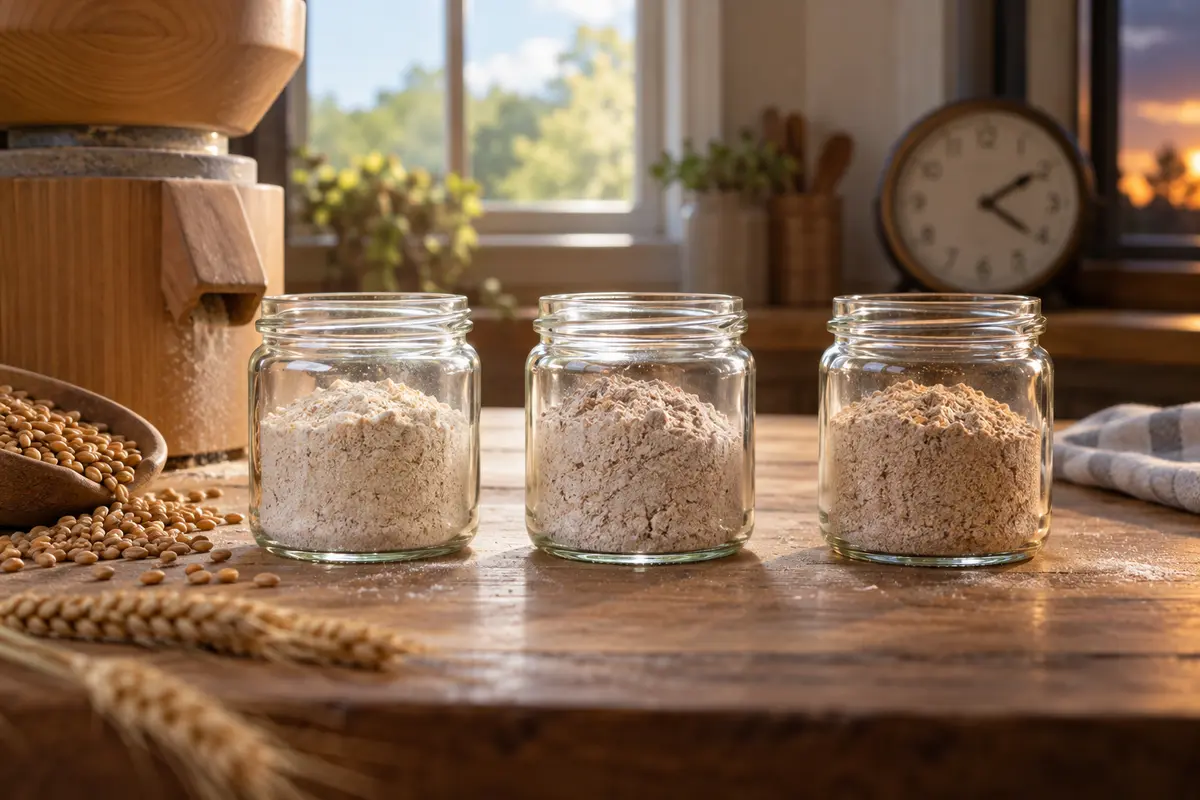
Grinding breaks the kernel into many small particles and mixes endosperm, bran, and germ. Far more surface area is exposed to oxygen, germ lipids meet enzymes more readily, and volatile aromas can escape. Those changes begin after milling, but flour does not cross a nutritional cliff at hour 12 or 24.
The useful answer
This guide gives you a starting point, then shows you what to observe and record in your own kitchen. Grain variety, mill setting, temperature, and recipe design all matter more than a single universal rule.
Milling starts a clock—but not a stopwatch
Be skeptical of precise internet claims that most nutrients disappear within a day unless the claim names the nutrient, temperature, storage condition, and measurement method.
What you may notice in the first day
| Time | Likely observation | Practical response |
|---|---|---|
| Immediately | Strongest sweet, grassy, or nutty aroma; flour may be warm | Spread briefly to cool if needed, then mix or cover |
| 1–6 hours | Temperature equalizes; volatile aroma begins softening | Keep covered and dry |
| 6–24 hours | Subtle aroma and handling changes may appear | Still excellent for baking; judge the dough normally |
| Days to weeks | Oxidation and flavor decline become more relevant | Refrigerate or freeze if not using soon |
Enzymes, lipids, and oxygen
Whole flour contains the germ’s lipids and naturally occurring enzymes. Milling removes the kernel’s protective architecture, making chemical and enzymatic reactions easier. Lipid oxidation is one reason whole-grain flour has a shorter quality life than intact berries or refined white flour.
That does not mean warm flour becomes rancid on the walk from mill to mixing bowl. Time, oxygen, temperature, light, and moisture work together. Cool, airtight storage slows quality loss.
Does flour absorb water differently after resting?
Fresh flour’s baking behavior depends heavily on particle size, grain moisture, and milling consistency. A short flour-and-water rest often changes dough more dramatically than leaving dry flour in a jar for a day. Bran and damaged starch continue absorbing water once mixed.
If today’s flour behaves differently from yesterday’s, check grain lot, mill setting, dough temperature, and water measurement before blaming the calendar.
The practical Grainiac rule
- Mill what you expect to use.
- Use it immediately when fresh aroma is part of the pleasure.
- If plans change, cool the flour, seal it, and refrigerate or freeze it.
- Store berries—not months of flour—for the best long-term stability.
Freshness matters. Panic does not improve bread.
Useful tools
Affiliate disclosure: As an Amazon Associate I earn from qualifying purchases. Recommendations are selected for practical usefulness.