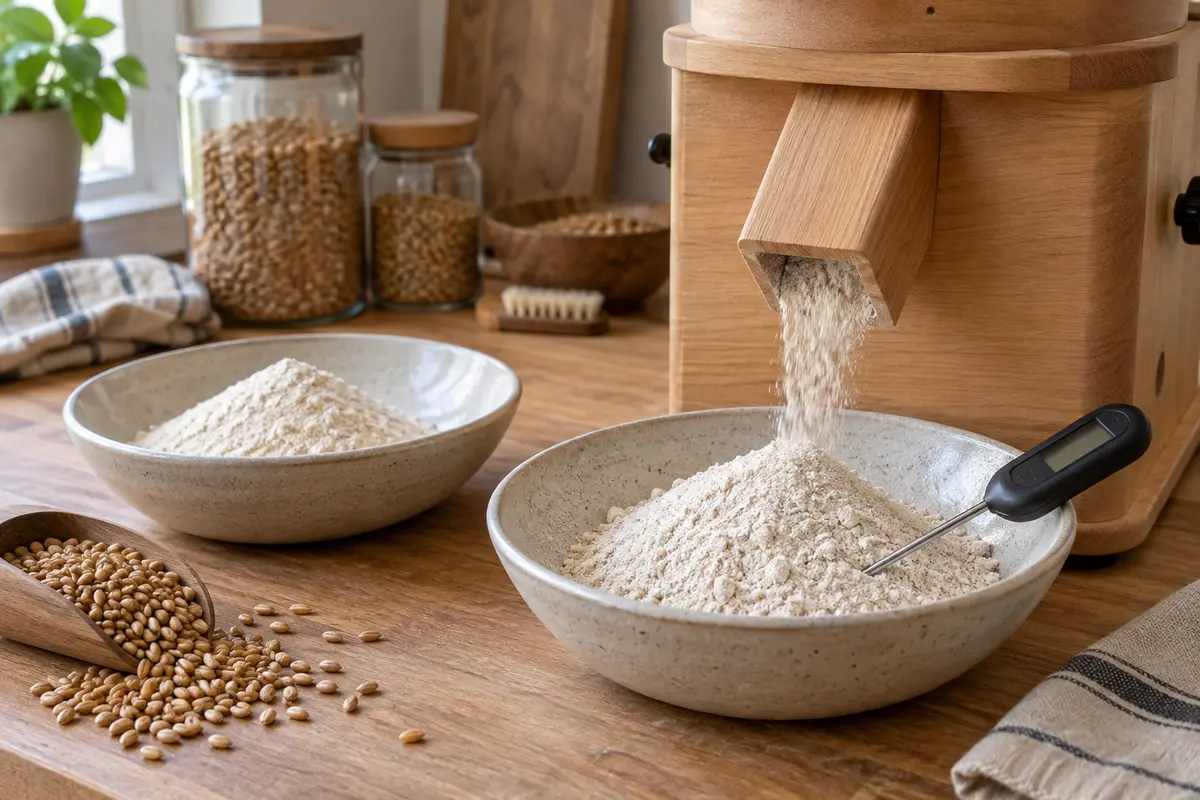
Home mills convert mechanical work into heat. Fine settings, hard grain, long continuous batches, warm rooms, and restricted airflow can all raise flour temperature. But a briefly warm flour sample is not the same as flour held at high temperature for a long time.
The useful answer
This guide gives you a starting point, then shows you what to observe and record in your own kitchen. Grain variety, mill setting, temperature, and recipe design all matter more than a single universal rule.
Warm flour is not automatically damaged flour
Claims that a single temperature instantly “kills all nutrients” usually collapse several different processes—enzyme activity, vitamin stability, protein denaturation, and oxidation—into one dramatic sentence.
Measure before worrying
- Place an instant-read probe in the flour as it exits or immediately after the batch.
- Measure the starting grain and room temperatures.
- Repeat for a normal batch and a long batch.
- Record mill setting and batch weight.
The hottest point may occur late in a long batch. Touch is useful but imprecise; a thermometer turns anxiety into a number.
What heat can influence
| Concern | What matters |
|---|---|
| Aroma | Warmth can speed loss of volatile compounds |
| Oxidation | Heat, oxygen, time, and exposed germ lipids interact |
| Dough temperature | Warm flour raises final dough temperature and fermentation speed |
| Enzymes/proteins | Effect depends on temperature and exposure time; there is no one universal home-milling cutoff |
Simple temperature controls
- Keep berries in a cool, dry room.
- Mill smaller batches when the mill or flour becomes progressively hotter.
- Let the mill rest between large batches.
- Use the finest setting the recipe needs—not the finest setting the machine can physically survive.
- Spread warm flour in a shallow bowl for a few minutes before sealing or mixing.
Do not introduce condensation by moving uncovered frozen grain directly into a humid kitchen. Cool and dry beats cold and damp.
The more immediate baking issue
For most home bakers, flour temperature matters first because it changes final dough temperature. Flour at 95°F can push a dough into a much faster fermentation than flour at 70°F. Adjust mixing water so the finished dough lands near the formula’s target.
If flour regularly exits uncomfortably hot, shorten batches and contact the mill manufacturer. Otherwise, measure, manage, and keep baking.
Useful tools
Affiliate disclosure: As an Amazon Associate I earn from qualifying purchases. Recommendations are selected for practical usefulness.