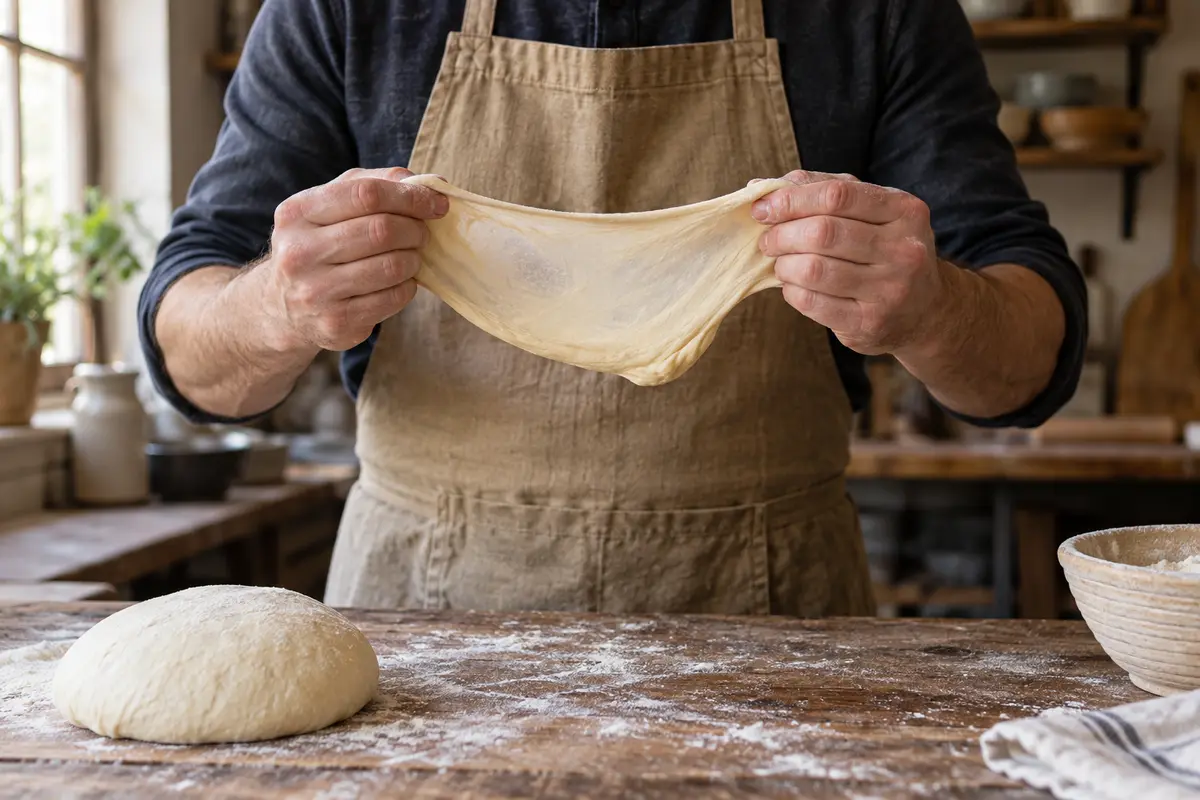
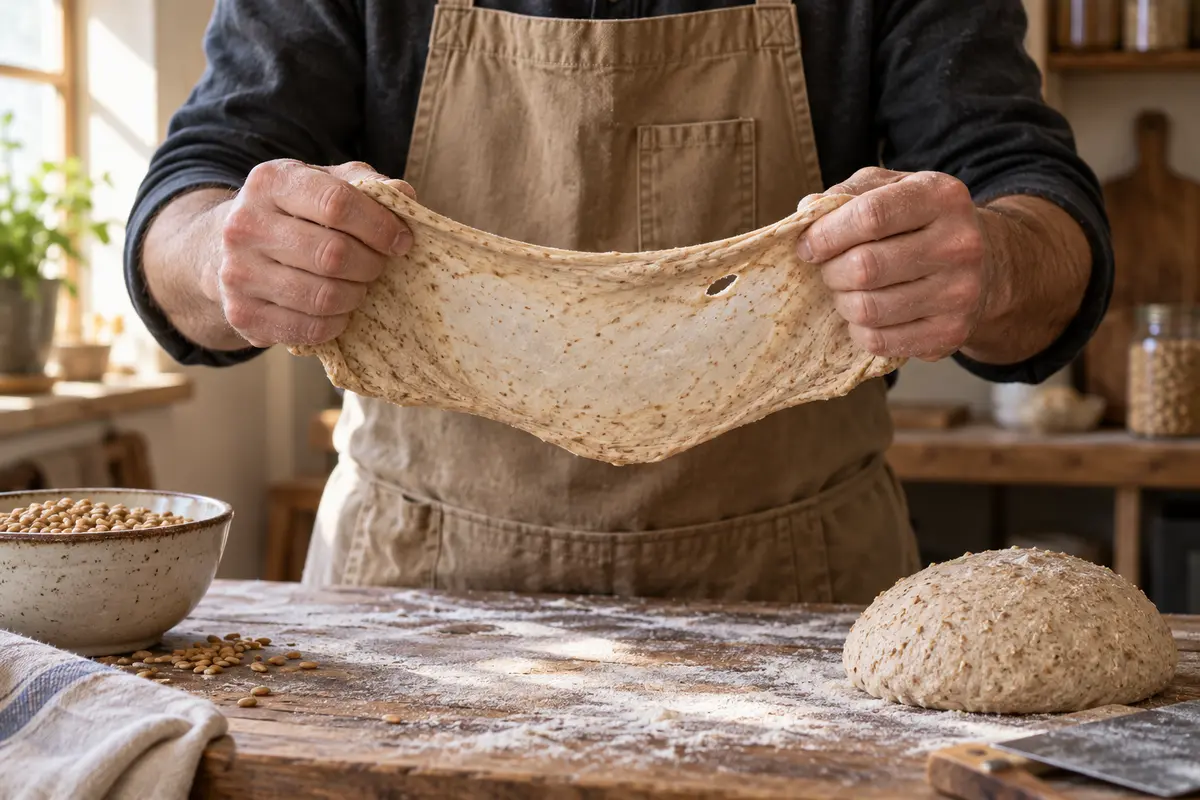
The classic windowpane test stretches dough until it becomes a thin translucent film without tearing. It is useful for refined strong-wheat dough because it shows an organized, extensible gluten network. It is not a universal certificate that every bread dough must earn.
The useful answer
This guide gives you a starting point, then shows you what to observe and record in your own kitchen. Grain variety, mill setting, temperature, and recipe design all matter more than a single universal rule.
A perfect window is a modern-wheat benchmark
Why fresh-milled dough looks different
- Bran interrupts the film. Large particles bind water and physically disrupt continuity.
- The germ adds lipids and non-endosperm material.
- Ancient wheats have different gluten quantity and quality. High protein on a label does not guarantee strong bread dough.
- Particle size varies. Coarse flour tears sooner than finely milled or lightly sifted flour.
What “developed enough” looks like
Stop mixing when the dough is more cohesive, smoother, elastic enough to hold a rounded shape, and able to stretch into a partial, cloudy membrane before tearing. During bulk fermentation, a few gentle folds should increase organization without making the dough glossy and slack.
| Grain | Better endpoint |
|---|---|
| Hard white/red wheat | Moderately thin window with visible bran |
| Spelt | Smooth, extensible partial window; stop before slackness |
| Kamut | Supple stretch, moderate film, no aggressive kneading |
| Emmer | Cohesive and elastic enough for a pan |
| Einkorn | Thick sticky stretch; no expectation of a clear film |
| Rye | Windowpane is not an appropriate target |
The danger of chasing transparency
Continued mixing can warm the dough and push delicate ancient-grain gluten past its useful peak. Warning signs include increasing shine, greater stickiness, loss of body, smearing around the bowl, and tearing that worsens instead of improves.
Once overmixed, more mixing is rarely the cure. Stop, rest briefly, use gentle folds, and choose a pan if the dough cannot support free-standing shape.
A better test bake
Make two identical small loaves. Mix one only to cohesion plus two early folds. Mix the second until you would normally demand a full windowpane. Keep every other variable equal. Compare dough temperature, handling, height, and crumb. The loaf—not the membrane—should decide your future method.
Useful tools
Affiliate disclosure: As an Amazon Associate I earn from qualifying purchases. Recommendations are selected for practical usefulness.