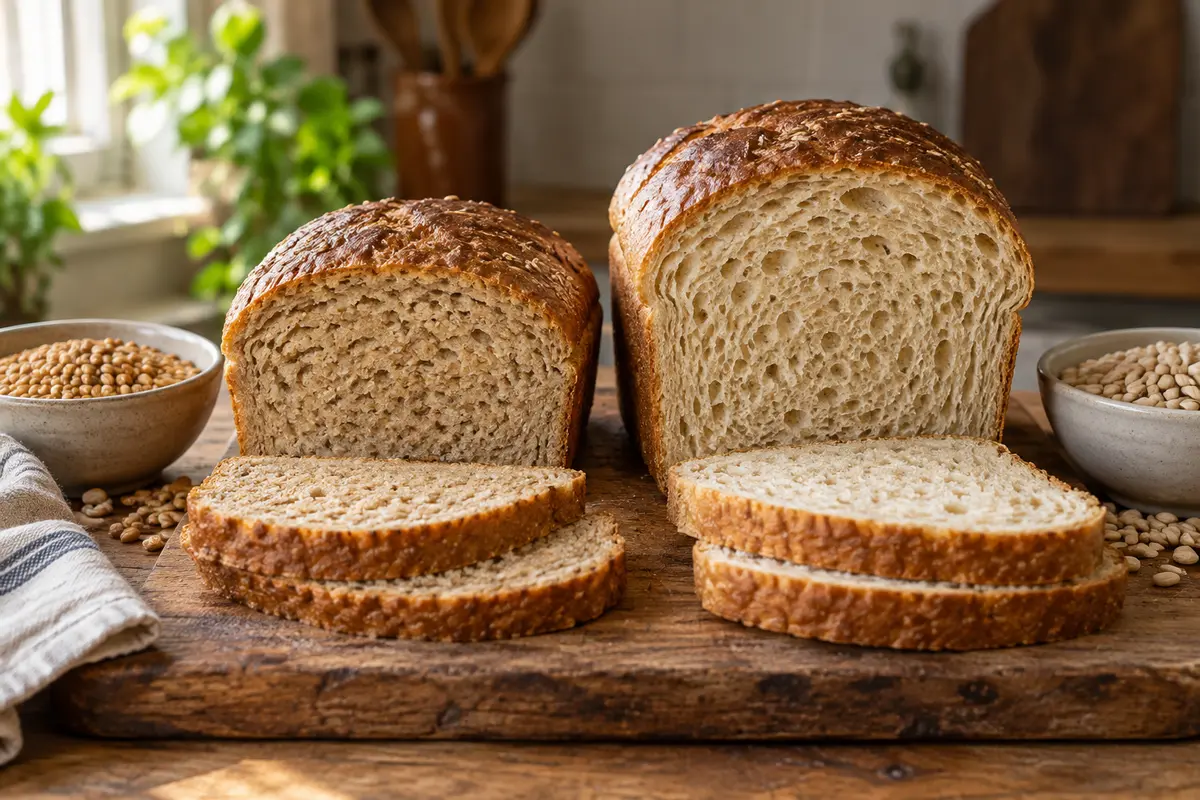
A 100% ancient-grain loaf delivers the clearest grain flavor and keeps the formula entirely within that grain. A blend usually delivers more height, a more open crumb, and wider fermentation tolerance. Neither is dishonest. They are different tools for different bread.
The useful answer
This guide gives you a starting point, then shows you what to observe and record in your own kitchen. Grain variety, mill setting, temperature, and recipe design all matter more than a single universal rule.
“Better” needs a job description
What changes when you blend
| Quality | 100% ancient grain | Ancient grain + strong wheat |
|---|---|---|
| Flavor | Most distinctive | Still clear at 50–70% |
| Loaf height | Usually lower | Usually taller |
| Crumb | Tender, often tighter | Lighter and more elastic |
| Handling | Less forgiving | Wider mixing/proofing window |
| Best shape | Often a pan loaf | Pan or free-standing |
Reasonable starting blends
| Grain | Start here for a tall loaf | Move toward 100% when… |
|---|---|---|
| Spelt | 70% spelt / 30% strong wheat | You can stop mixing and proofing before slackness |
| Kamut | 70/30 | A tender golden pan loaf is desired |
| Emmer | 50–70% emmer | Flavor matters more than maximum height |
| Einkorn | 50–70% einkorn | You are comfortable with sticky, fragile pan dough |
| Rye | 20–40% rye for wheat-style bread | You are following a rye-specific sourdough formula |
Do not force every loaf into the same silhouette
Einkorn is not failed bread flour because it does not produce a towering modern-wheat boule. A short, aromatic pan loaf may be exactly right for the grain. Likewise, blending is sensible when the bread must hold sandwiches, inclusions, or a free-standing shape.
Choose the loaf first, then select the grain percentage. Chasing social-media holes in a dough built for tenderness is how good grain becomes disappointing bread.
Run a useful comparison
Bake two small pan loaves at the same total flour, hydration, salt, leavener, dough temperature, and fermentation endpoint. Make one 100% ancient grain and the other 70/30. Compare dough handling, proof time, height, crumb, flavor, and next-day texture. That test answers “better” for your kitchen.
Useful tools
Affiliate disclosure: As an Amazon Associate I earn from qualifying purchases. Recommendations are selected for practical usefulness.